
banner-why-daymark.jpg
Daymark IT Insights

Enterprise IT, cloud, security, and AI guidance from Daymark’s technology experts.

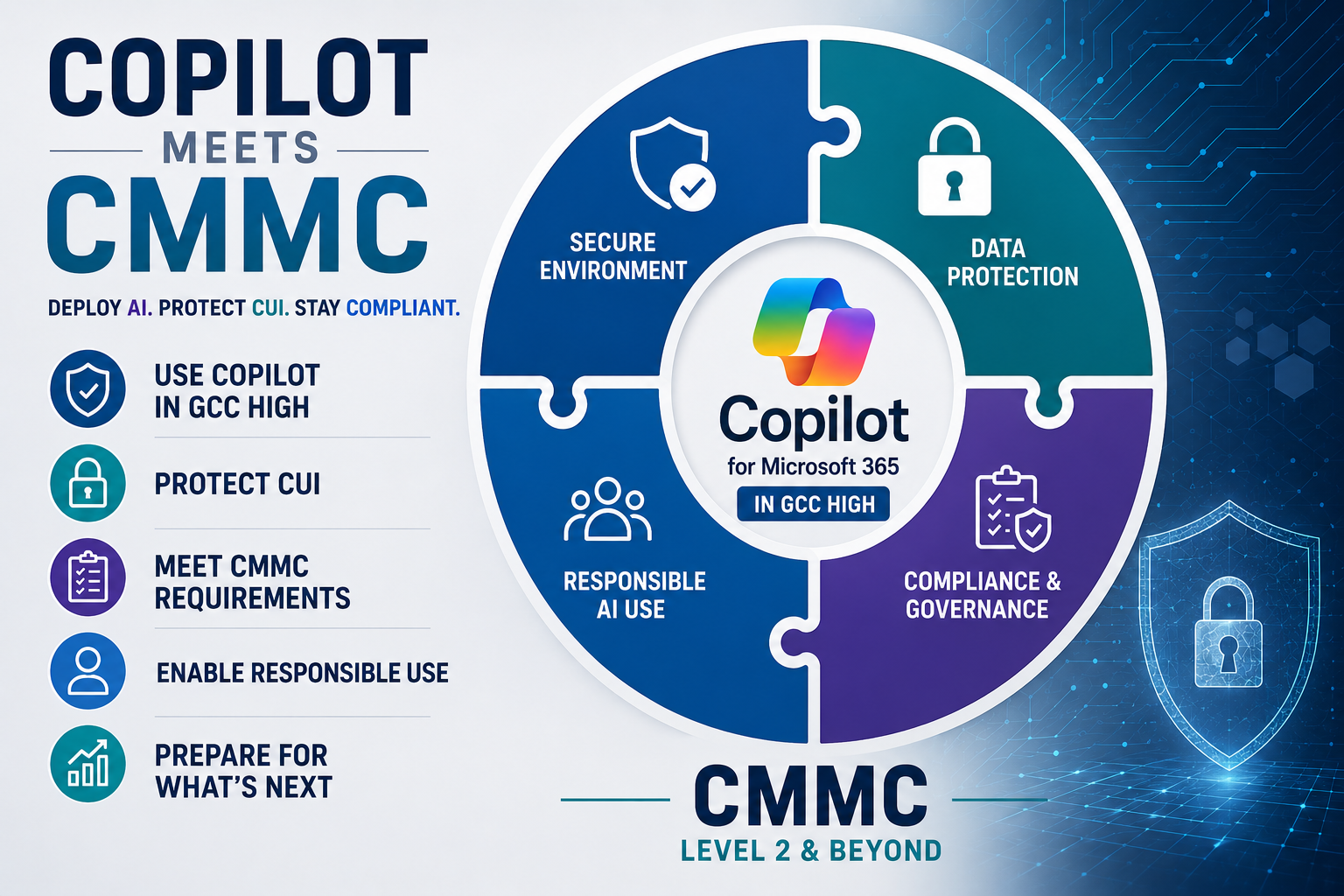
Top 10 GCC High Copilot Readiness Services

A program manager at a mid-sized defense contractor asks a simple question: "Can we use Copilot to summarize meeting notes about our Navy contract?" The IT director pauses. The contract references ITAR-controlled technical data. The company uses Microsoft 365 Commercial. The answer is no, not today, and the path to yes is longer than anyone wants to hear.

This scene plays out across the Defense Industrial Base every week. The pressure to adopt AI is real. So is the regulatory wall that separates commercial Microsoft 365 from environments allowed to touch Controlled Unclassified Information (CUI). Bridging the two is what Microsoft 365 Copilot deployment in GCC High readiness services are designed to do.

What GCC High Copilot Readiness Services Actually Cover

Read More
Wed, Apr 22, 2026
Share:   

Azure Content Understanding: Unlocking Value from Unstructured Content at Scale

Overview

Most organizations are rich in content but poor in usable insight. Documents, PDFs, images, videos, and audio files hold critical business information, yet much of it is locked away in formats that are difficult to automate, analyze, or govern. This creates operational drag, manual review cycles, and increased costs.

Azure Content Understanding is Microsoft’s AI service designed to change that. It helps organizations consistently analyze and understand unstructured content and turn it into structured, reliable, and reusable information. Instead of fragmented tools and manual effort, Content Understanding provides a unified way to extract meaning from content with accuracy, confidence scores, and governance built in.

For technology leaders, the value is not just AI capabilities, but faster time to value, reduced operational cost, and greater confidence in automation and AI-driven decisions.

Why Use Azure Content Understanding

Read More
Mon, Apr 20, 2026
Share:   

Fabric Data Agent vs Fabric Operations Agent: Understanding the Difference


Overview

Microsoft Fabric continues to evolve beyond a unified analytics platform and into an agent-driven system that actively helps users understand data and operate systems. Two of the most important building blocks of this direction are Data Agents and Operations Agents. While both leverage AI, they serve very different purposes. One focuses on understanding data, and the other focuses on acting on real-time conditions. Together, they represent Microsoft’s shift toward embedding intelligence directly into analytics and operations rather than layering it on afterward.

What Data Agents Are Good At

Read More
Mon, Apr 13, 2026
Share:   

Microsoft Fabric Item Recovery (Soft Delete): What You Need to Know

Overview

As Microsoft Fabric environments mature and become more collaborative, the risk of accidental deletion increases. A data engineer cleaning up a workspace, an analyst removing unused assets, or a contributor misunderstanding dependencies can easily delete the wrong item. Until recently, that deletion was permanent.

Microsoft Fabric now introduces item-level recovery through soft delete, providing a critical safety net for supported Fabric items. This capability complements existing workspace retention and adds fine-grained protection at the item level.

Item recovery allows deleted items to be retained for a configurable period, during which authorized users can restore them or permanently delete them. This feature is currently available in preview and must be explicitly enabled at the tenant level.

Prerequisites and Configuration

Read More
Mon, Apr 06, 2026
Share:   

CMMC Enclave vs. Full GCC High Migration for Defense Contractors

Defense contractors facing CMMC compliance have a fundamental architecture decision to make before they spend a dollar on licensing or migration services. Should you move your entire organization into a Microsoft 365 GCC High tenant, or should you build a CMMC enclave that isolates only the users and systems that handle Controlled Unclassified Information (CUI)? The answer depends on how much of your business actually touches regulated data, what your contracts require, and how much complexity your IT team can realistically manage.

This guide compares both approaches so you can make the right call for your organization's compliance posture, budget, and operations.

Key Insights: What You Need to Know About CMMC Enclave vs. Full GCC High Migration

Read More
Wed, Apr 01, 2026
Share:   

Microsoft Fabric Database Hub: A Major Step Forward in Database Management

Overview

At FabCon 2026, Microsoft took another important step toward reshaping how organizations manage databases by announcing the Database Hub in Microsoft Fabric. While the Database Hub is still in early access and not yet generally available, it represents a meaningful shift in how Microsoft is thinking about database management at scale.

For years, database teams have operated across fragmented tools, portals, and management experiences depending on whether the database lived on‑premises, in Azure PaaS, or in a SaaS environment. As data estates grow and AI workloads place greater pressure on operational data, that fragmentation becomes a real problem. The Database Hub is Microsoft’s answer to this challenge, providing a unified control plane for managing databases across the enterprise from within Fabric.

Anyone running SQL Server today, whether on‑premises or in Azure, should be paying close attention. This is not just another management experience. It is a signal of where Microsoft is taking databases as part of a single, converged data platform.

What the Database Hub Is

Read More
Mon, Mar 30, 2026
Share:   

Microsoft 365 Copilot for Defense: Secure AI Use in DoD Environments

Defense contractors have spent the last two years watching commercial organizations transform their workflows with AI while wondering when Microsoft 365 Copilot for defense environments would actually become available. That wait ended in December 2025, and the implications for how DIB organizations work with sensitive data are significant.

Key Insights: What You Need to Know About Microsoft 365 Copilot for Defense

  • Copilot for defense contractors became a reality in December 2025 when Microsoft announced general availability of Microsoft 365 Copilot in GCC High, the sovereign cloud environment required for handling Controlled Unclassified Information (CUI) under DoD contracts.
  • Copilot in GCC High operates within a physically separated infrastructure where all data stays in U.S.-based data centers managed exclusively by screened U.S. personnel, meeting DFARS 252.204-7012, ITAR, and CMMC requirements.
  • Secure AI for DoD use depends on architecture, not promises. Web grounding is turned off by default in GCC High to prevent data leakage outside the compliance boundary, and Microsoft Entra ID for Government enforces role-based access controls.
Read More
Fri, Mar 27, 2026
Share:   

GCC High Cost and Licensing for Defense Contractors

If your organization handles Controlled Unclassified Information (CUI) under a Department of Defense contract, you already know that Microsoft 365 GCC High is the cloud environment built for your situation. What most defense contractors underestimate is the true GCC High cost once you move past the per-user license fee and into the full picture of migration, operations, and long-term compliance.

This guide breaks down what GCC High actually costs for defense contractors, which Microsoft licensing options apply, and where the budget surprises tend to hide.

Key Insights: What You Need to Know About GCC High Cost and Licensing

Read More
Tue, Mar 24, 2026
Share:   

Fabric Security: Control Plane vs Data Plane

Overview

Microsoft Fabric security is built on two distinct layers that are often confused but serve very different purposes:

    • Control plane access determines what you can do in Fabric, such as creating items, managing workspaces, and sharing content.
    • Data plane access determines what data you can actually see or interact with inside OneLake.

For much of Fabric’s early life, workspace roles were used as the primary security boundary. That works for collaboration, but it becomes problematic as platforms scale and data products need stronger governance.

This is where OneLake security comes in. It introduces native, fine-grained security directly at the storage layer, allowing organizations to separate operational permissions from data access. At FabCon, Microsoft announced that OneLake security is going GA in April 2026, signaling that this model is ready to become the standard for enterprise Fabric deployments.

Control Plane Access: Workspace Roles

Read More
Mon, Mar 23, 2026
Share:   

Back at the Microsoft Fabric Community Conference!

Daymark Solutions is at FabCon for a second year in a row!

There’s something energizing about being back at the Microsoft Fabric Community Conference. After attending last year, it’s great to once again be surrounded by people who are genuinely excited about Fabric, from data engineers and analysts to architects and partners building real world solutions every day.

Read More
Tue, Mar 17, 2026
Share: