
banner-why-daymark.jpg
Daymark IT Insights

Enterprise IT, cloud, security, and AI guidance from Daymark’s technology experts.

Azure Content Understanding vs Azure Document Intelligence: One Platform, Less Confusion, More Value

Overview

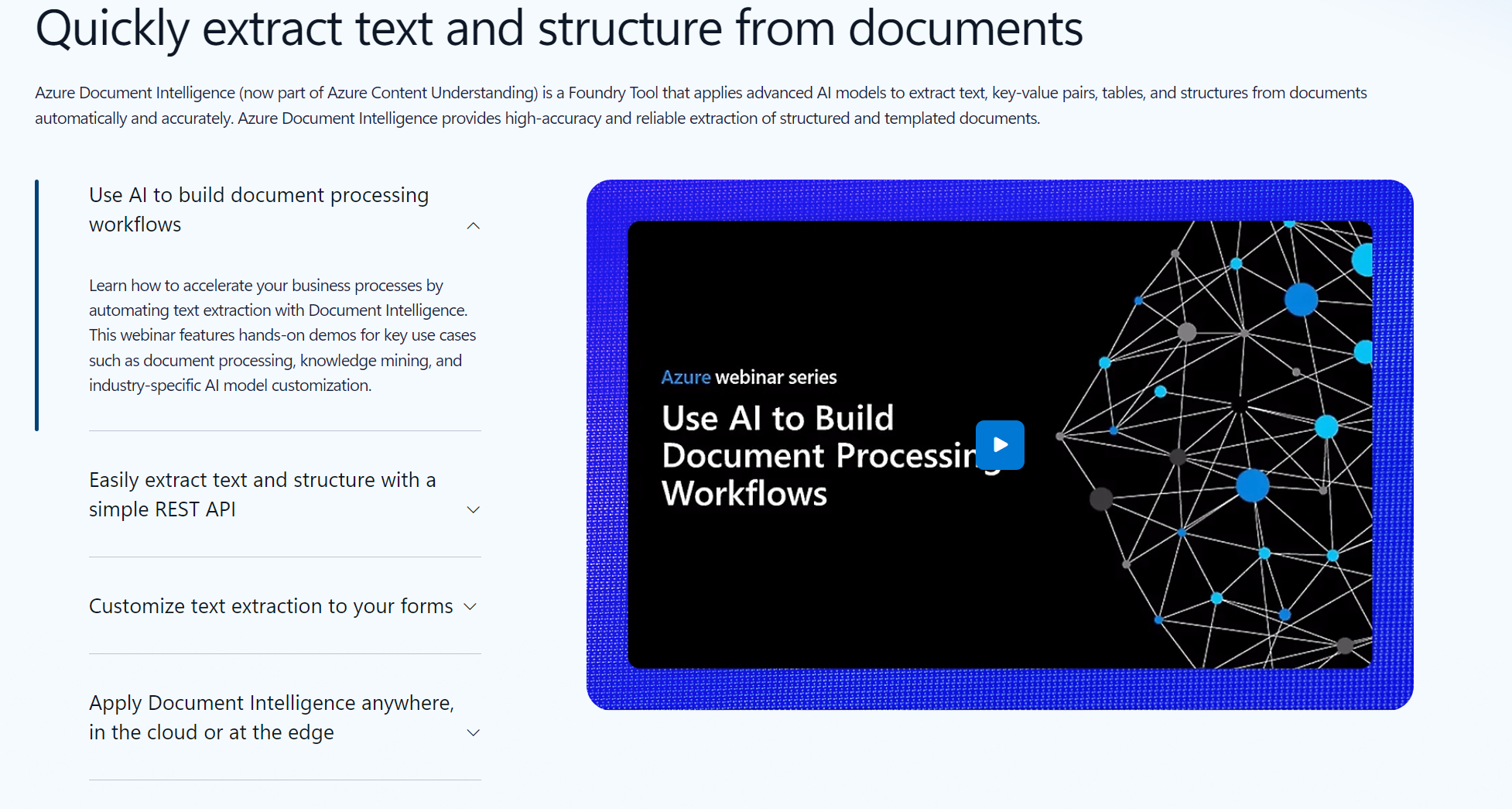
If you've worked with Microsoft's AI services for document processing over the past few years, you've likely come across both Azure Content Understanding and Azure Document Intelligence. The challenge was often figuring out which service was the right fit for your use case.

Document Intelligence focused on extracting information from forms, invoices, contracts, and other business documents, while Content Understanding expanded into images, audio, video, and broader content analysis. Today, Microsoft is simplifying that story by bringing these capabilities together under Azure Content Understanding.

The Transition to Azure Content Understanding

Read More
Mon, Jul 06, 2026
Share:   

Why Model Context Protocol (MCP) Matters for Enterprise AI Strategy

Overview

As organizations move from AI experimentation to real-world deployment, a common challenge emerges: connecting AI models to the systems where business data lives.

Large language models (LLMs) are powerful, but on their own, they are limited. They rely on static training data and lack direct access to real-time systems, enterprise data, and operational workflows.

That is where the Model Context Protocol (MCP) comes in.

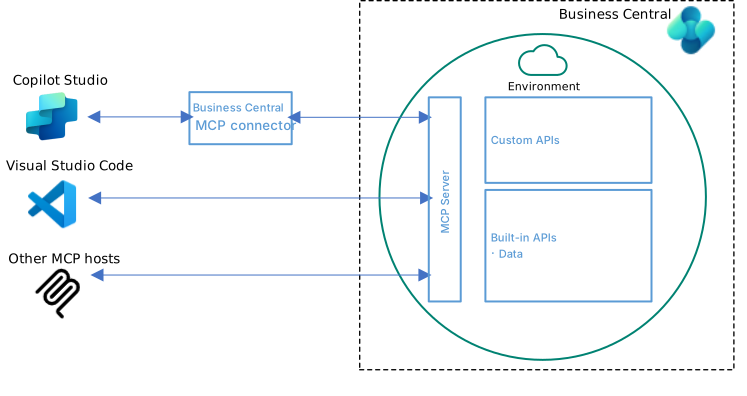
MCP is an open standard that enables AI applications to securely and consistently connect to external tools, data sources, and systems. At a high level, it represents a shift from isolated AI models to connected, context-aware systems that can operate within real business environments.

As enterprises scale AI initiatives, MCP is emerging as a foundational capability for enabling more dynamic, integrated, and production-ready AI solutions.

What is MCP, Why it Matters, and How it Fits into the Modern AI Stack

Read More
Mon, Jun 29, 2026
Share:   

Azure HorizonDB: Microsoft’s AI-Ready PostgreSQL Database for Modern Applications

Overview

Azure HorizonDB is Microsoft’s new fully managed, PostgreSQL-compatible database service built for modern cloud and AI applications. It is designed for mission-critical workloads that need predictable performance, enterprise-grade security, high availability, and scalable architecture while preserving compatibility with the PostgreSQL ecosystem.

At a high level, HorizonDB matters because it brings transactional data, cloud-native scale, and AI capabilities closer together. Instead of forcing teams to stitch together separate systems for relational data, vector search, AI model interaction, and data pipelines, HorizonDB is designed to support more of those patterns directly within a PostgreSQL-compatible platform.

This is especially important as organizations modernize applications and begin embedding AI into everyday business workflows. The database layer is becoming more than a system of record. It is becoming part of the intelligent application architecture.

Key High-Level Characteristics Everyone Should Know

Read More
Mon, Jun 22, 2026
Share:   

Everpure: Data Primacy in Practice

Two new GA products, Unified Data Plane updates and four Intelligent Control Plane additions from Everpure's annual user conference.

The Short Version

▸ Pure Storage rebranded to Everpure; Q1 FY2027 revenue was $1.1 billion, up 35% year-over-year, reflecting the company's stated expansion from storage provider to data management platform

▸ Everpure Data Intelligence, formerly 1touch, is now available: universal discovery, automated governance and a semantic knowledge graph exposed through APIs and MCP

▸ Everpure Data Stream, based on the NVIDIA AI Data Platform reference design, is available now and reduces raw AI data preparation from months to minutes

▸ Everpure announced Unified Data Plane updates including Evergreen//One Overdrive and Everpure Cloud Azure Native Virtual Machines

▸ Four Intelligent Control Plane features ship from Q2 through Q4 2026: Copilot Workflow Execution, Enhanced Cyber Anomaly Detection, Workload Rebalance & Mobility and Fusion Compliance & Agentic Triage

▸ Cyber resilience framing positions immutable SafeMode snapshots and Human-in-the-Loop authorization as the final recovery backstop, not a perimeter concern

Read More
Thu, Jun 18, 2026
Share:   

Web IQ: Extending Microsoft’s IQ Stack to the Open Web

Overview

As organizations continue adopting generative AI and AI agents, one of the biggest challenges is making sure those systems are grounded in accurate, current, and trusted information. Large language models are powerful, but they are limited by what they were trained on and may not always have access to the most recent or specialized information needed to answer a business question. Microsoft IQ documentation describes Microsoft IQ as a unified intelligence layer for enterprise AI, bringing together capabilities such as Work IQ, Fabric IQ, Foundry IQ, and now Web IQ.

Web IQ is the newest addition to Microsoft’s growing IQ stack. It is designed to give AI systems and agents access to fresh, real-world information from across the web, including web pages, news, images, and videos. Instead of relying only on model knowledge or static enterprise content, Web IQ helps agents discover, rank, extract, and package relevant web-based evidence so responses can be more timely, grounded, and useful.

What Web IQ Is

Read More
Mon, Jun 15, 2026
Share:   

Compute Designed for Agents

Build 2026 just validated the local AI strategy and gave IT the compliance answer it needed. Here is the architecture, and why it matters.

The Short Version

Build 2026 was a platform architecture event, not a hardware launch

MAI (Microsoft AI) models run identically on-device and in Azure, dual-mode by design

Foundry Control Plane routes between MAI models on based on policy

Agent 365 governs both venues through Entra, Defender and Purview

Scout is the first end-to-end proof that the pieces compose

Tiered routing cuts blended token cost from $18.40 to $2.31 per million

Read More
Tue, Jun 09, 2026
Share:   

Microsoft’s New AI Models: A Strategic Shift for Enterprise AI

Overview

As organizations continue evaluating generative AI, one of the most important decisions is no longer whether to use AI. It is how to choose the right AI capabilities for the right business outcomes.

Microsoft’s latest AI model announcements show a clear shift toward a broader, more enterprise-ready AI ecosystem. Through its MAI model family, Microsoft is introducing models focused on reasoning, coding, image generation, transcription, voice, and business-specific customization. These include MAI-Thinking-1, MAI-Code-1-Flash, MAI-Image-2.5, MAI-Transcribe-1.5, MAI-Voice-2, and Microsoft Frontier Tuning.

For executives and decision makers, the key takeaway is simple: AI is moving from a general-purpose tool to a portfolio of specialized capabilities. Organizations will increasingly select different models for different needs based on accuracy, speed, cost, governance, and business value.

Microsoft’s Move Toward AI Independence

Read More
Fri, Jun 05, 2026
Share:   

RAG, Prompt Engineering, and Fine-Tuning: Choosing the Right AI Approach for Business Value

Overview

As organizations continue adopting generative AI, one of the most important decisions is understanding how to improve the quality, accuracy, and usefulness of AI outputs. Three common approaches are Retrieval-Augmented Generation, also known as RAG, prompt engineering, and fine-tuning. Each approach helps AI perform better, but they solve different problems and should be used for different business needs.

For executives and decision makers, the goal is not to choose the most technical option. The goal is to choose the approach that best aligns to the business outcome. Some organizations need AI to access current enterprise data. Others need better instructions and more consistent responses. Some need a model that is more deeply customized to a specific domain, workflow, or communication style. Understanding the difference between these approaches helps organizations invest in AI more strategically and avoid unnecessary complexity.

Retrieval-Augmented Generation

Read More
Mon, Jun 01, 2026
Share:   

Beyond Out-of-the-Box AI: How Fine-Tuning Drives Business Value


Overview

As organizations continue adopting generative AI, many leaders quickly realize that general-purpose AI models are not always optimized for their specific business needs. While large language models are powerful, they are typically trained on broad public datasets and may not fully understand an organization’s terminology, workflows, customer interactions, or industry-specific requirements.

Fine-tuning helps solve this challenge by taking a pre-trained AI model and further adapting it using smaller, targeted datasets that are specific to the business or use case. Instead of building a model entirely from scratch, organizations can refine an existing model to improve accuracy, consistency, tone, and relevance for their environment.

For executives and decision makers, fine-tuning represents a way to move AI from being a general productivity tool into a more business-aware solution. It can help organizations improve customer experiences, streamline operations, create more accurate AI assistants, and better align AI outputs with internal policies and processes.

Common use cases include:

Read More
Mon, May 25, 2026
Share:   

Microsoft 365 Copilot in GCC High: What DIB Subcontractors Need to Know About Deploying AI Without Breaking CMMC

Program managers keep asking their leadership when they can use Copilot to summarize contract documents. What do I tell them?

The IT team has been holding the line for two years with a clear answer: not yet, not for anything that touches Controlled Unclassified Information. That answer is no longer current.

Microsoft 365 Copilot reached general availability in GCC High in December 2025, and the question has shifted from "is it available?" to "how do we deploy it without breaking our CMMC posture?"

Read More
Mon, May 18, 2026
Share: