

Overview
As organizations move from AI experimentation to real-world deployment, a common challenge emerges: connecting AI models to the systems where business data lives.
Large language models (LLMs) are powerful, but on their own, they are limited. They rely on static training data and lack direct access to real-time systems, enterprise data, and operational workflows.
That is where the Model Context Protocol (MCP) comes in.
MCP is an open standard that enables AI applications to securely and consistently connect to external tools, data sources, and systems. At a high level, it represents a shift from isolated AI models to connected, context-aware systems that can operate within real business environments.
As enterprises scale AI initiatives, MCP is emerging as a foundational capability for enabling more dynamic, integrated, and production-ready AI solutions.
What is MCP, Why it Matters, and How it Fits into the Modern AI Stack
The Model Context Protocol (MCP) is an open standard that enables AI applications to securely and consistently connect to external tools, data sources, and systems.
At its core, MCP acts as a universal integration layer for AI, standardizing how models access real-time information and interact with enterprise environments.
This is critical because traditional AI models operate on static training data and have limited ability to interact with live systems. MCP bridges that gap by allowing AI to retrieve current data, execute actions, and integrate directly into business workflows.
From an enterprise perspective, MCP solves a major architectural challenge. Without a standard approach, organizations must build custom integrations between each AI application and every system they rely on. This creates complexity and slows down adoption. MCP simplifies this by introducing a shared protocol that reduces integration overhead and enables reusable, scalable connections.
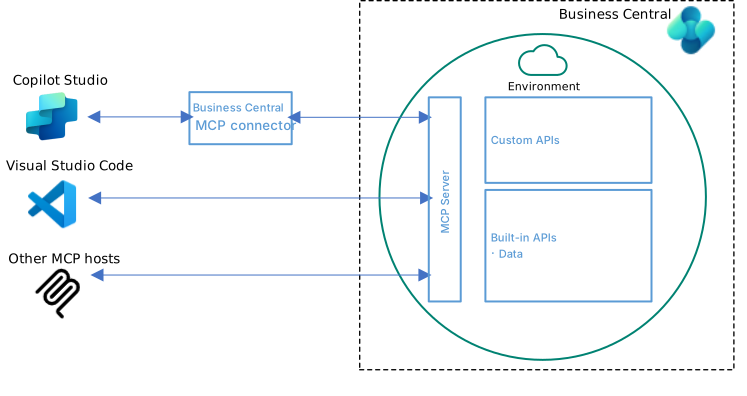
In the modern AI stack, MCP sits between the AI application and the enterprise systems it needs to access. AI applications such as copilots, agents, or development tools act as the interaction layer, while MCP provides the standardized communication layer that connects those applications to external systems like databases, APIs, and services.
This architecture allows AI to move beyond answering questions and into executing real tasks, making AI more accurate, context-aware, and actionable. It also enables organizations to build once and reuse integrations across multiple AI experiences, creating consistency and reducing vendor lock-in.
Final Thoughts
The Model Context Protocol is not just another AI feature. It is quickly becoming a foundational capability for enterprise AI at scale.
As organizations move toward copilots and agent-driven workflows, the ability to securely connect AI systems to real business data and tools is critical. MCP provides a standardized approach to solving this challenge, reducing integration complexity and enabling scalable, repeatable architectures.
In practice, MCP allows AI to evolve from a passive assistant into an active participant in business operations. By sitting between AI applications and enterprise systems, it enables models to access data, trigger actions, and deliver more relevant outcomes.
The real value of MCP is not just in connectivity, but in what it enables. Organizations can build once and reuse integrations across copilots, agents, and AI-driven workflows, creating consistency while reducing vendor lock-in.
Let’s talk. Whether you’re evaluating how MCP fits into your enterprise AI strategy or just getting started with AI, we can help you navigate the path forward and turn ideas into real-world outcomes.