
Apple validated the hybrid AI architecture. Microsoft extended that architecture into enterprise governance. For regulated organizations, that distinction matters more than the headline.
The Short Version
▸ Apple's Worldwide Developer’s Conference (WWDC) 2026 platform confirms the hybrid AI architecture: local inference, private cloud and a framework abstracting model selection from application code
▸ That validation stops at the routing layer. Apple does not currently offer a public, agent-specific enterprise governance plane comparable to Microsoft Agent 365's combination of Entra identity controls, Purview data governance and Defender security telemetry.
▸ Microsoft's Agent 365 brings agent identity, data classification and behavioral telemetry into a single enterprise control plane
▸ For regulated organizations, the question is whether governance is designed before agents go into production or in response to a compliance finding
In June 2026, Apple and Microsoft each announced a hybrid AI architecture. They had not coordinated, but arrived at the same design anyway: model families that span device and cloud, a routing framework that abstracts model selection from application code, and a platform layer that places inference based on cost, latency and privacy requirements.
The architecture question is starting to be answered.
What is not settled is governance. Apple's platform was built for developers building on managed hardware. Microsoft's was built for organizations that need to control what agents are authorized to do, log what they actually access and produce a record that holds up when a regulator asks. For enterprises operating under compliance requirements, those are not equivalent capabilities, and the gap between them is now an IT decision that cannot wait.
What Apple Confirmed
Apple's WWDC 2026 announcements validated the direction the industry has been moving toward: hybrid AI, with smaller models running locally, larger models running in the cloud and a developer framework abstracting much of the model integration from the application.
Apple's Foundation Models (AFMs) framework gives developers a common native Swift API for working across Apple's on-device models, Apple Foundation Models running on Private Cloud Compute, and cloud models such as Claude and Gemini through providers that conform to Apple's Language Model protocol. That abstraction lets developers change model back ends with minimal changes to the application logic.
Apple also introduced its third-generation model family: AFM 3 Core and AFM 3 Core Advanced on-device, and AFM 3 Cloud, AFM 3 Cloud Pro and ADM 3 Cloud for image generation and editing on Private Cloud Compute. For AFM 3 Cloud Pro, Apple extended Private Cloud Compute onto NVIDIA GPUs inside Google Cloud infrastructure, maintaining the same privacy guarantees while accessing additional compute capacity for its most demanding workloads.
That matters. Apple is not simply adding AI features to applications. It is building a platform where local inference, private cloud inference and third-party models can all participate in the developer experience.
In that sense, Apple validated the same broad architecture Microsoft emphasized at Build 2026: model families that span device and cloud, a framework layer that reduces application dependency on any single model and a future where AI workloads are placed according to cost, latency, capability and privacy requirements.
But the overlap stops at the architecture layer.
What Apple's Platform Does Not Include
Apple's platform is strongest where Apple has always been strongest: individual productivity, privacy-preserving user experiences and deep integration across hardware, operating system and applications.
That is not the same thing as enterprise agent governance.
AFM is exposed primarily through Apple's developer frameworks and runs on Apple silicon. Apple's Foundation Models framework is built for developers, not compliance teams. Apple's public materials do not describe an Agent 365-like enterprise control plane for centralized agent inventory, organizational model-use logging, runtime behavior monitoring or policy enforcement for agents across a fleet. Apple's platform defers authentication for third-party models to the provider. Apple's public materials do not describe an Agent 365-like organizational identity layer for assigning agents distinct enterprise identities or enforcing permission boundaries as they operate across business systems.
Apple's System Orchestrator is designed around the user. Its job is to coordinate Apple Intelligence around the individual user's context, privacy boundaries and sensitive actions. That is the right design for a personal AI assistant. It is a different design than what enterprises need when agents act on behalf of the organization, access shared systems and produce outputs a compliance team may need to explain.
There is no enterprise data classification plane comparable to Purview that attaches sensitivity labels to a workload and enforces handling rules as the task moves between applications. There is no behavioral telemetry layer comparable to Defender that flags when an agent accesses data outside its normal pattern and sends that signal into the organization's existing security operations workflow.
That does not make Apple's architecture weak. It means Apple is solving a different problem.
Apple is designing for private, fast, local-first intelligence on personal devices. Microsoft is designing for governed agents operating inside an enterprise control plane.
For regulated organizations, that distinction is the whole story.
What Agent 365 Provides
Microsoft Agent 365, which reached general availability in May 2026, is the enterprise control plane for agents. It gives organizations the ability to observe, govern and secure agents operating across Microsoft and third-party platforms, extending Entra, Purview and Defender into a unified framework for agent oversight.
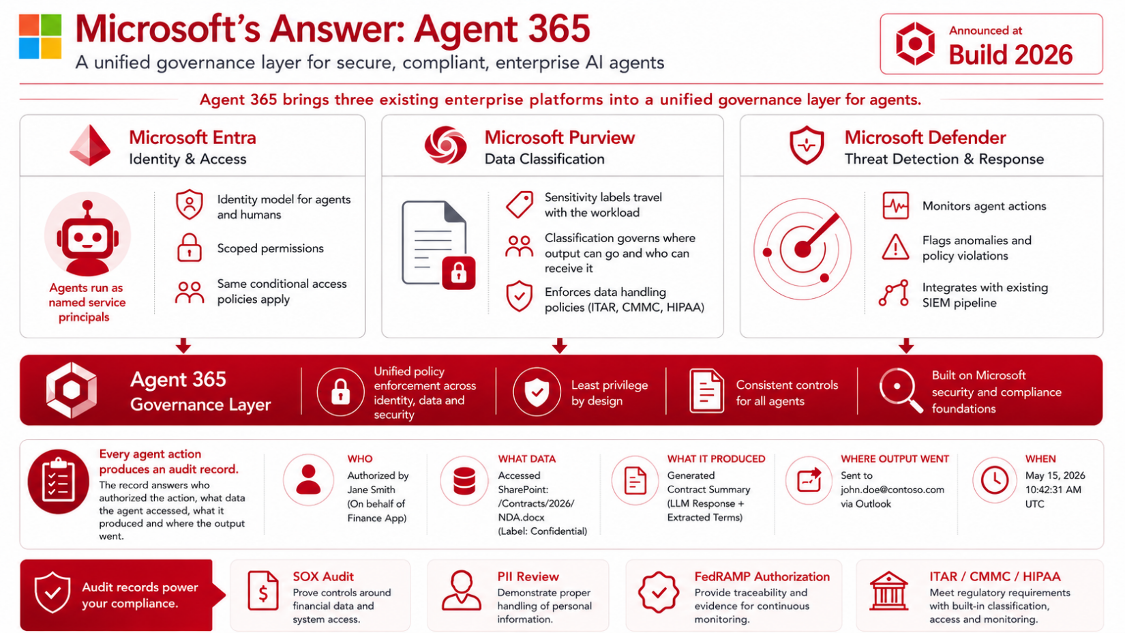
Entra provides the identity model. Agents can run under distinct agent identities with scoped permissions, governed through the same identity systems enterprises already use for users, applications and workloads. An agent authorized to read contracts in SharePoint should not automatically be authorized to query the HR directory. That permission boundary belongs at the identity layer before the agent ever executes a task.
Purview provides the data protection and classification plane. Sensitivity labels, DLP policies and data handling controls matter when agents touch regulated or confidential information. If an agent summarizes a document labeled Confidential, that classification should influence where the output can go, who can receive it and whether the action is permitted under the organization's data handling policies.
For organizations subject to ITAR, CMMC, HIPAA, SOX or other regulatory requirements, that is not an optional feature. It is the difference between a productivity experiment and a governable enterprise system.
Defender provides the threat detection and runtime defense layer. Agents introduce a new class of activity that security teams need to monitor: tool use, data access, unusual workflows, prompt-driven behavior and actions taken across systems. Microsoft is extending Defender and Intune to cover locally running agents, adding discovery, policy enforcement, runtime blocking and alerting to the management plane. Several capabilities entered public preview in June 2026, with initial support focused on specific agent types such as OpenClaw.
Together, these capabilities are designed to improve auditability across agent identity, permissions, tool usage, data access and security events, correlated across Entra, Defender and Purview where those services are in use. That audit trail is the compliance answer.
For a SOX review, a PII data-handling investigation, or a CMMC assessment, the question is not whether the model was capable. The question is whether the organization can explain who authorized the action, what data was accessed, what the agent produced and where the output went.
That is the problem Agent 365 is built to solve.
The Mixed-Platform Reality
Most large organizations will run both platforms.
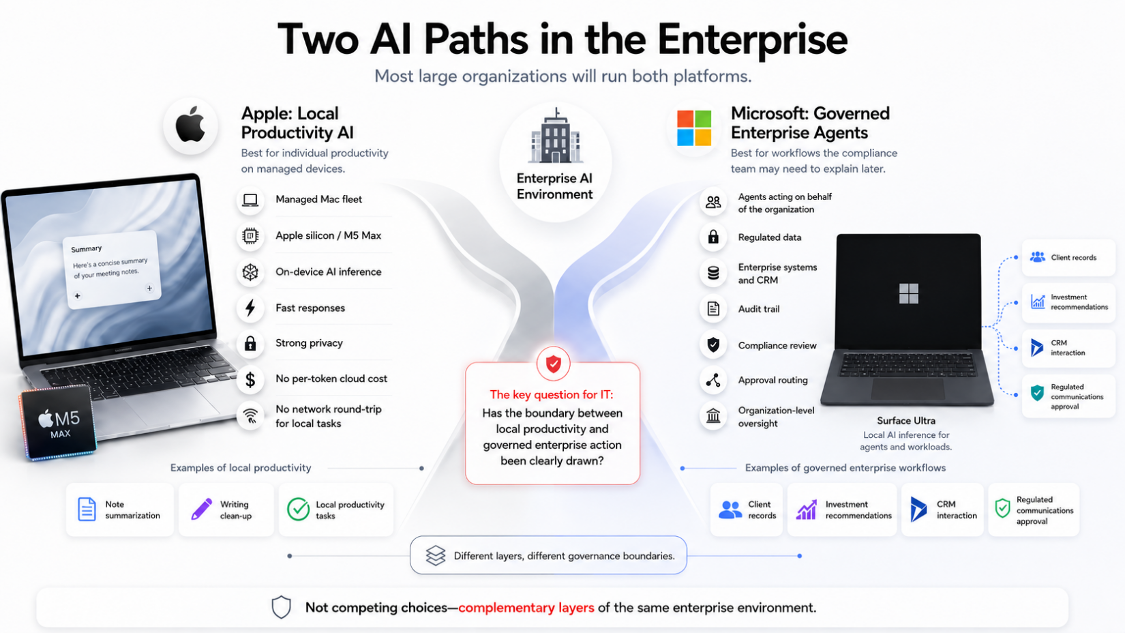
The Mac fleet is not going away. Apple silicon continues to be a strong platform for on-device AI workloads, and M5 Max hardware raises the ceiling for local inference with high unified memory capacity and bandwidth. For professional users, Apple's local AI story is compelling: fast responses, no per-token cloud cost for on-device models, strong privacy positioning and no network round-trip for tasks that can run locally.
That economics argument is real. It applies to both Apple and Microsoft's local AI strategies.
But the governance story does not follow the same pattern.
Apple's architecture is the right answer for individual productivity on managed devices: fast, private, cost-efficient inference for tasks that do not require organization-level oversight.
Microsoft's architecture is the right answer for agents that act on behalf of the organization, touch regulated data, interact with enterprise systems or produce outputs a compliance team may need to explain later.
These are not necessarily competing choices. They are different layers of the same enterprise environment.
A portfolio analyst may use Apple Intelligence on a managed Mac to summarize notes, clean up writing or perform local productivity tasks. That same firm may require Microsoft-governed agents for workflows that access client records, generate investment recommendations, interact with CRM data or route regulated communications for approval.
The key question is whether IT has drawn a clear boundary between those two categories.
The Governance Question Is the Enterprise Question
The WWDC June 2026 platform announcements substantially settled the architecture debate.
Hybrid AI is where the industry has landed. Local inference will handle routine, private and latency-sensitive work. Cloud inference will handle larger, more complex and more compute-intensive tasks. Platform frameworks will increasingly abstract model selection from application development.
The open question for enterprise IT is no longer whether hybrid AI is the right architecture. The question is governance.
Which agents require organizational identity? Which agents need scoped permissions? Which agents will touch regulated data? Which outputs need sensitivity labels, retention policies or review workflows? Which agent actions must be captured in an audit trail? Which behaviors need to be monitored by security operations?
Those questions need answers before agents move into production.
Designing governance in response to a compliance finding is more expensive than designing it before the first agent is deployed. The organizations that move fastest with AI will not be the ones that ignore governance. They will be the ones that make governance reusable, repeatable and built into the platform from the beginning.
Daymark's practice around Microsoft Foundry, Agent 365 and hybrid AI architecture exists to help organizations get ahead of that decision. Contact us to schedule an architecture review before your agents start accumulating decisions that will need to be explained.
Apple validated the architecture. Microsoft advanced the enterprise control plane.
For regulated organizations, that is the distinction that matters.
About Daymark
Daymark Solutions has been an IT Integrator since 2001, headquartered in Burlington, Massachusetts and serving customers across North America. Daymark designs, implements and supports enterprise infrastructure across two converging practices: a modern data center practice spanning virtualization, enterprise storage, data protection, networking and cybersecurity as well as a Microsoft cloud and AI practice covering Azure, M365, Copilot, Copilot Studio, Foundry and Fabric.
Daymark holds Microsoft Frontier AI partner status, the designation Microsoft reserves for partners with the advanced certifications and proven delivery record to lead enterprise AI engagements. Daymark also operates a dedicated Azure Government practice, including GCC High enclave design and implementation for defense industrial base contractors managing CUI and pursuing CMMC compliance.