

Overview
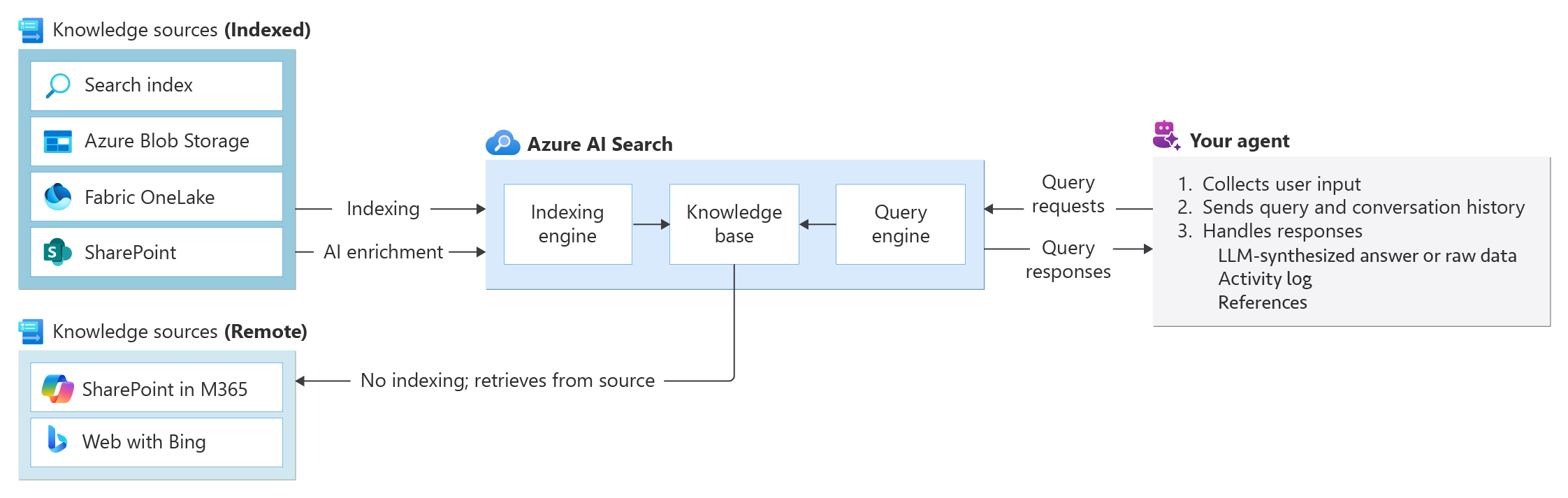
As organizations adopt generative AI, one challenge consistently rises to the top: how do you connect AI models to your organization's data? Large Language Models are powerful, but their value increases significantly when they can access relevant business content. This is where Azure AI Search plays a critical role. Azure AI Search is Microsoft's fully managed search and retrieval platform that enables organizations to index, search, and retrieve information from structured and unstructured data sources while supporting traditional search applications, Retrieval-Augmented Generation (RAG), copilots, and AI agents.
At its core, Azure AI Search acts as a dedicated knowledge layer between your data and your applications. It supports traditional full-text search, vector search, hybrid search, semantic ranking, multimodal search, and agentic retrieval capabilities. Whether you're building a public-facing search experience, an internal knowledge portal, or an AI-powered chatbot, Azure AI Search provides the retrieval capabilities needed to deliver accurate, context-aware responses.
An In-Depth Look at Azure AI Search
Azure AI Search is built around a simple workflow: ingest data, create an index, and query the index. Content can be imported from Azure Blob Storage, Azure SQL, Cosmos DB, OneLake, SharePoint, and numerous other supported sources. During ingestion, organizations can enrich content with AI capabilities such as OCR, document analysis, chunking, vectorization, summarization, and metadata extraction before making the content searchable.
Azure AI Search is commonly used for:
- Enterprise knowledge management and document search.
- Retrieval-Augmented Generation (RAG) applications.
- Custom copilots and AI assistants.
- Agentic retrieval for AI agents and workflow automation.
- Customer support knowledge bases.
- Product catalogs and website search experiences.
- Semantic and vector search workloads.
One of Azure AI Search's greatest strengths is its ability to combine multiple search methods in a single platform. Traditional keyword search can be combined with vector search and semantic ranking to improve relevance and dramatically enhance AI-generated responses.
Integrating Azure AI Search
Azure AI Search is designed to integrate directly into applications, AI platforms, and automation workflows. Microsoft provides REST APIs and SDKs for .NET, Python, Java, and JavaScript, making it easy for developers to build search experiences and AI-powered applications.
Organizations frequently integrate Azure AI Search with:
- Azure OpenAI Service.
- Azure AI Foundry and Foundry IQ.
- Microsoft Copilot and custom agent solutions.
- Azure Blob Storage and Data Lake solutions.
- SharePoint and Microsoft 365 content repositories.
- Custom web applications and enterprise portals.
For many organizations implementing RAG, Azure AI Search becomes the retrieval layer while Foundry or OpenAI Service provides the reasoning and response generation layer. This architecture helps limit hallucinations and grounds responses in approved company content.
Understanding the Billing Model
Azure AI Search currently offers two primary pricing models.
Dedicated Pricing
The traditional model uses dedicated capacity based on Search Units (SUs). Organizations select a service tier and pay for provisioned compute and storage resources regardless of utilization. This model works best for predictable, production-scale workloads with consistent usage patterns.
Serverless Pricing
Azure AI Search also offers a serverless model that charges based on actual consumption. Costs are measured using compute consumption and indexed storage, making it ideal for bursty workloads, development environments, and scenarios where usage patterns are highly variable.
When planning costs, organizations should consider:
- Search queries and workload volume.
- Indexed content size.
- Vector storage requirements.
- AI enrichment execution.
- Semantic ranking usage.
- Agentic retrieval workloads.
As search indexes grow and AI workloads expand, monitoring storage, indexing activity, and query volume becomes increasingly important for cost optimization.
Final Thoughts
Azure AI Search has evolved from a traditional enterprise search platform into one of Microsoft's most important building blocks for enterprise AI. By combining search, indexing, vector retrieval, AI enrichment, and agentic retrieval capabilities into a single service, it provides the foundation needed to connect business data with modern AI applications.
Organizations should consider Azure AI Search whenever they need secure, scalable access to large amounts of information, particularly when building copilots, AI assistants, knowledge management systems, or Retrieval-Augmented Generation solutions. While simple use cases may only require keyword search, organizations investing in Azure OpenAI, Microsoft Foundry, Agent 365, or custom AI initiatives will often find Azure AI Search becoming a foundational component of their architecture.
Let's talk about how Azure AI Search fits into your AI strategy. Whether you're building a RAG solution, deploying AI agents, integrating with Foundry, or modernizing enterprise search, the right retrieval architecture can dramatically improve response quality, security, and user adoption while ensuring your AI solutions remain grounded in trusted organizational data.