

Overview
Microsoft operates multiple Azure cloud environments to support a wide range of regulatory, security, and compliance needs. Two of the most important, and most commonly misunderstood, are Azure Commercial (Public) and Azure Government. While both environments are built on the same underlying Azure technology stack, they are designed for fundamentally different use cases, particularly when paired with Microsoft 365 offerings such as Commercial, GCC, GCC High, and DoD.
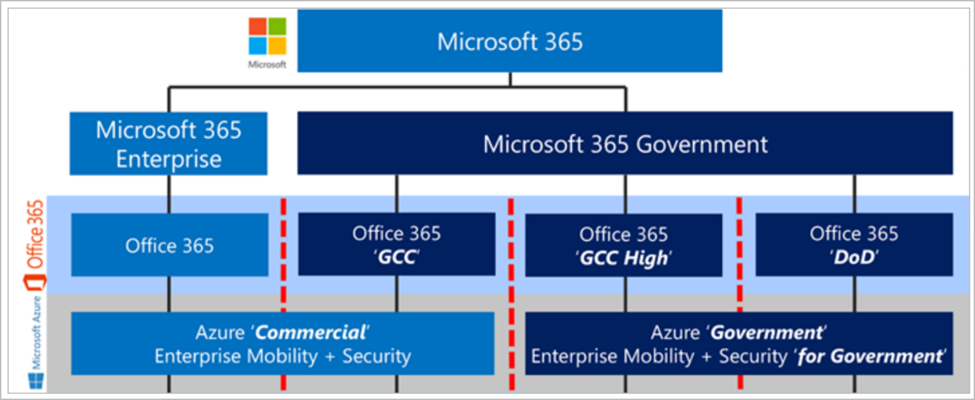
Azure Commercial, also referred to as global or public Azure, is Microsoft’s standard cloud platform used by enterprises worldwide. It offers the broadest service catalog, the fastest access to new features, and global regional availability. Both Microsoft 365 Commercial tenants and GCC (Government Community Cloud – Moderate) tenants rely on Azure Commercial as their underlying Azure platform.
Azure Government, by contrast, is a separate, sovereign cloud built exclusively for U.S. government agencies and their authorized partners. It operates in physically isolated U.S. datacenters, is managed by screened U.S. persons, and is authorized for high‑impact government workloads. This separation is not merely contractual or logical; it is enforced across the infrastructure, network, and identity layers.
Because of these enforced boundaries, Azure Government is the required Azure platform for organizations using Microsoft 365 GCC High or Microsoft 365 DoD. Both of these Microsoft 365 environments are paired with Microsoft Entra ID in Azure Government, ensuring identity, data residency, and access controls remain within the same sovereign cloud boundary.
Comparison: Azure Commercial vs Azure Government
Cloud Alignment with Microsoft 365
A common source of confusion is how Microsoft 365 environments map to Azure:
- M365 Commercial → Azure Commercial
- M365 GCC (Moderate) → Azure Commercial
- M365 GCC High → Azure Government
- M365 DoD → Azure Government (DoD regions)
GCC High and DoD tenants cannot rely on Azure Commercial without breaking compliance alignment. Their identity, data residency, and service dependencies are explicitly designed to remain within Azure Government boundaries.
URLs and Endpoints
One of the most visible differences between Azure Commercial and Azure Government is endpoint separation.
Azure Commercial uses endpoints such as:
- portal.azure.com
- login.microsoftonline.com
- management.azure.com
Azure Government uses distinct, sovereign endpoints, including:
- portal.azure.us
- login.microsoftonline.us
- management.usgovcloudapi.net
These differences affect portals, authentication, APIs, SDKs, PowerShell, CLI, and automation tooling. Scripts written for Azure Commercial often require explicit endpoint changes to work in Azure Government.
This separation is intentional and prevents accidental data movement or identity crossover between sovereign and non‑sovereign clouds.
Feature Availability and Parity
Azure Government uses the same core Azure technologies as Azure Commercial, including IaaS, PaaS, and SaaS offerings. However, feature availability is not simultaneous.
New services and capabilities are typically released first in Azure Commercial. They then under go additional security validation, compliance assessments, and authorization reviews before being made available in Azure Government. As a result, Azure Government often lags behind Azure Commercial in:
- New service introductions
- Feature enhancements
- Preview availability
Microsoft explicitly documents these differences and maintains separate service availability matrices for Azure Government.
While most core services eventually reach Azure Government, architects must design with the expectation that parity will arrive later, not immediately.
Compliance and Regulatory Scope
Compliance is the primary reason Azure Government exists.
Azure Government maintains authorizations and accreditations that include:
- FedRAMP High
- DoD SRG Impact Levels 2, 4, and 5
- ITAR and EAR
- DFARS
- CJIS
- IRS 1075
- NIST SP 800-171
- FIPS 140
These authorizations apply specifically to Azure Government regions such as US Gov Virginia, US Gov Texas, and designated DoD regions, and cannot be inherited from Azure Commercial.
For DoD IL5 workloads, Azure Government enforces additional isolation and configuration requirements, reinforcing that compliance isachieved through both platform controls and customer architecture decisions.
Final Thoughts
Azure Commercial and Azure Government are built on the same foundation, but they serve very different missions.
Azure Commercial prioritizes global scale, rapid innovation, and broad service availability. Azure Government prioritizes sovereignty, controlled access, and regulatory compliance. The trade‑offs include different URLs, delayed feature availability, and stricter operational constraints that are intentional and necessary.
When designing solutions:
- Use Azure Commercial for commercial workloads and GCC (Moderate) scenarios.
- Use Azure Government when supporting GCC High, DoD, ITAR, DFARS, or IL4/IL5 requirements.
- Plan for endpoint differences and feature lag early in the architecture process.
- Treat compliance as a foundational design requirement, not a post‑deployment configuration.
Do you have a requirement or upcoming need to build in Azure Government? Let’s talk.