
Overview
Modernizing a data pipeline isn’t just about adopting the latest technology, it’s about choosing the right foundation for your data. File formats play a critical role in performance, scalability, and governance. Two widely used formats in modern data lakes are Parquet and Delta. While Parquet is a columnar storage format optimized for analytics, Delta builds on Parquet by adding transactional consistency and metadata management. Understanding how they work together and when to use each is key to designing a future-ready architecture.
Key Considerations: Parquet vs Delta
What Is Parquet?
Parquet is an open-source, columnar storage format designed for efficient querying and compression. It’s widely used in big data ecosystems because:
- Columnar Storage: Ideal for analytical workloads where queries scan specific columns.
- Compression & Encoding: Reduces storage costs and improves read performance.
- Compatibility: Works seamlessly with Spark, Hive, Presto, and most data lake engines.
Parquet is excellent for read-heavy analytics but lacks features like ACID transactions and schema evolution tracking.
What Is Delta?
Delta Lake is an open-source storage layer that extends Parquet by adding:
- ACID Transactions: Ensures data consistency during concurrent writes.
- Schema Enforcement & Evolution: Prevents corrupt data and supports controlled schema changes.
- Time Travel: Query historical versions of data for auditing or rollback.
- Metadata Management: Stores transaction logs in JSON, enabling fast queries and reliability.
In short, Delta combines Parquet for data storage and JSON for metadata, making it ideal for streaming, batch, and machine learning pipelines where reliability and governance matter.
How Do They Work Together?
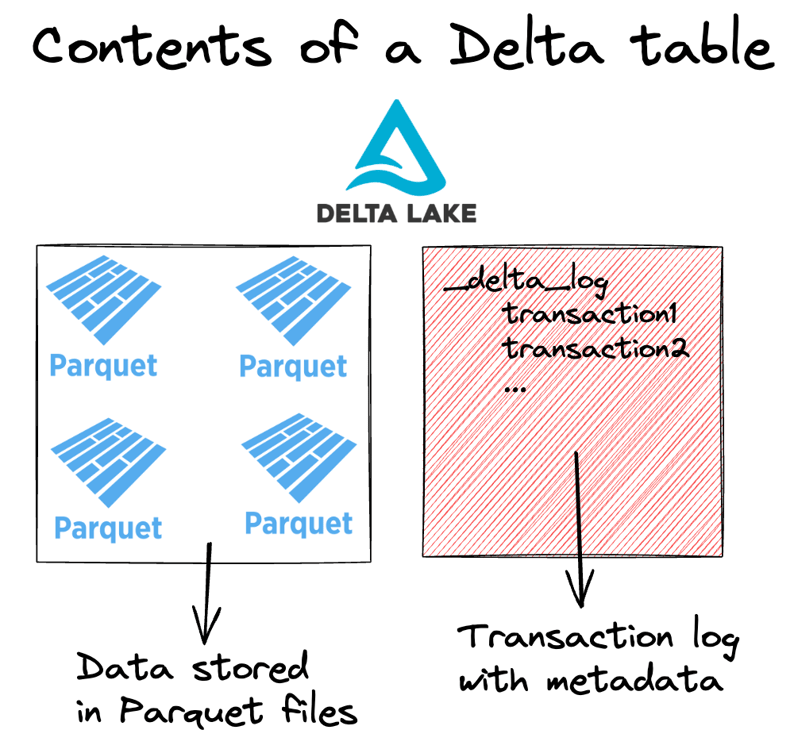
Delta files are essentially Parquet files plus a transaction log:
- Data blocks remain in Parquet format for efficient storage and analytics.
- A _delta_log directory stores JSON files that track changes, schema updates, and versions. This design means Delta retains Parquet’s performance benefits while adding enterprise-grade features.
When to Use Parquet vs Delta
- Use Parquet When:
- You need a lightweight, read-optimized format for static datasets.
- Governance and transactional consistency are not critical.
- Cost and simplicity are priorities.
- Use Delta When:
- You require ACID guarantees for concurrent writes.
- Your pipeline involves streaming ingestion or frequent updates.
- You need data versioning for compliance or reproducibility.
- Governance and reliability are non-negotiable.
Core Benefits of Delta
- Reliability: ACID transactions prevent partial writes and corruption.
- Flexibility: Supports batch and streaming in the same table.
- Governance: Built-in schema enforcement and auditability.
- Performance: Optimized reads via Parquet and fast metadata queries via JSON logs.
- Future-Ready: Enables advanced features like time travel and incremental processing.
Why This Matters
Choosing between Parquet and Delta isn’t just a technical decision, it impacts scalability, compliance, and operational efficiency. Delta’s hybrid approach makes it a strong candidate for modern data platforms where data integrity and governance are as important as performance.
Final Thoughts
Parquet remains a solid choice for static, analytical datasets, but Delta Lake is the evolution needed for dynamic, enterprise-grade pipelines. By leveraging Delta’s combination of Parquet and JSON, organizations can achieve transactional reliability, schema control, and historical tracking without sacrificing performance.
If you’d like to explore how Delta Lake can modernize your data architecture, feel free to connect with me on LinkedIn!