

Overview
For many years, organizations commonly relied on on‑premises SQL Server as their enterprise data warehouse. While this approach made sense when cloud platforms were immature, it is no longer necessary, or efficient, in modern analytics architectures. Microsoft Fabric fundamentally changes this model by providing purpose-built, cloud-native analytical engines that eliminate the need to manage traditional data warehouse infrastructure.
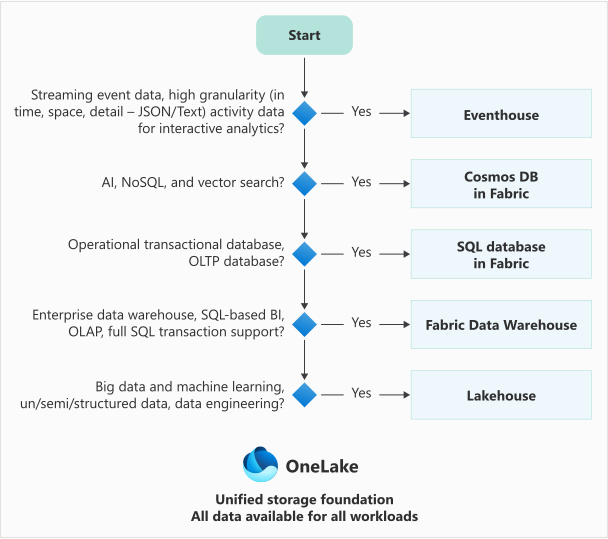
Within Fabric, SQL Database and Data Warehouse serve different but complementary roles. Understanding when to use each is critical to building a scalable, governed, and future-proof data platform.
Instead of lifting and shifting legacy SQL Server workloads into the cloud, organizations can now adopt services designed specifically for analytical patterns, elasticity, and tight integration with the broader Fabric ecosystem.
The Shift Away from On-Prem SQL Server as a Data Warehouse
Historically, SQL Server was used as both an operational database and a data warehouse. This created several challenges:
- Limited scalability without complex infrastructure upgrades
- Tight coupling between transactional and analytical workloads
- Operational overhead for patching, sizing, and performance tuning
- Difficulty integrating with modern analytics and AI platforms
Microsoft Fabric removes these constraints by providing separate engines optimized for transactional-style SQL access and large-scale analytical warehousing, all operating on OneLake and integrated with governance, security, and analytics tooling by default.
Microsoft explicitly positions Fabric as a replacement for traditional, infrastructure-heavy architectures rather than an extension of them.
What Is Fabric SQL Database?
Fabric SQL Database is a fully managed SQL engine optimized for operational and analytical querying within Fabric. It looks and feels like SQL Server from a development standpoint but operates as a cloud-native service tightly integrated with OneLake and Fabric experiences.
Key Characteristics
- Full T‑SQL compatibility for familiar development patterns
- Automatic scaling and management, no servers to patch or maintain
- Optimized for relational workloads with predictable performance
- Integrated security and governance through Fabric and Microsoft Purview
- Direct access to OneLake data without external movement
Fabric SQL Database is ideal when teams want strong SQL semantics, relational modeling, or need to support workloads migrating off legacy SQL Server without re-architecting everything at once.
Source: Microsoft Fabric SQL Database Overview
What Is Fabric Data Warehouse?
Fabric Data Warehouse is a cloud-scale analytical engine designed specifically for enterprise data warehousing scenarios.
It separates compute from storage and is optimized for large volumes of data, complex analytical queries, and concurrent BI workloads. Instead of thinking like a traditional row-based SQL Server system, this engine is designed for modern analytical patterns.
Key Characteristics
- Massively scalable analytical compute
- Separation of storage and compute for elasticity and cost control
- Optimized for star schemas and fact/dimension modeling
- High concurrency for BI tools like Power BI
- Native integration with Data Engineering, Data Science, and AI workflows
- Managed storage in OneLake with delta-based formats
Fabric Data Warehouse is intended to be the central analytical store for enterprise reporting, dashboards, and analytics, replacing traditional enterprise data warehouses built on on‑prem or IaaS SQL Server.
Source: Introduction to Data Warehousing in Microsoft Fabric
Fabric SQL Database vs Fabric Data Warehouse
Fabric SQL Database Is Best When:
- Migrating from existing SQL Server solutions
- Supporting relational or operational-style workloads
- Needing predictable, SQL-centric performance
- Enabling developers to continue using familiar T‑SQL patterns
- Supporting department-level or application-specific analytics
Fabric Data Warehouse Is Best When:
- Building an enterprise analytical platform
- Supporting large fact tables and historical analysis
- Serving high-concurrency Power BI workloads
- Implementing medallion or dimensional models at scale
- Centralizing analytics across multiple data domains
Rather than competing services, these capabilities are designed to coexist within Fabric. SQL Database can support application-level analytics, while Fabric Data Warehouse serves as the enterprise system of analytical record.
Why This Matters for Modern Analytics Architecture
The key difference from legacy approaches is that you no longer need to force-fit SQL Server into a role it was not designed for. Fabric allows workloads to align naturally with the right engine:
- Transactional and relational logic stays in SQL Database
- Large-scale analytics live in Fabric Data Warehouse
- Data is shared seamlessly through OneLake
- Governance, security, and lineage remain consistent
This eliminates architectural compromises that were once unavoidable in on-prem environments.
Final Thoughts
Using on‑prem SQL Server as a data warehouse was once the standard, but it is no longer the best choice. Microsoft Fabric provides cloud-native engines designed for their specific purposes, removing infrastructure complexity while improving scalability, security, and performance.
Choosing between Fabric SQL Database and Fabric Data Warehouse is not about picking a winner. It’s about aligning workloads to the right analytical engine and adopting a modern architecture that was never possible in traditional data center environments.
If you would like to discuss how to modernize your data warehouse strategy with Microsoft Fabric, or how to migrate away from legacy SQL Server-based architectures, feel free to connect with me on LinkedIn.