
Overview
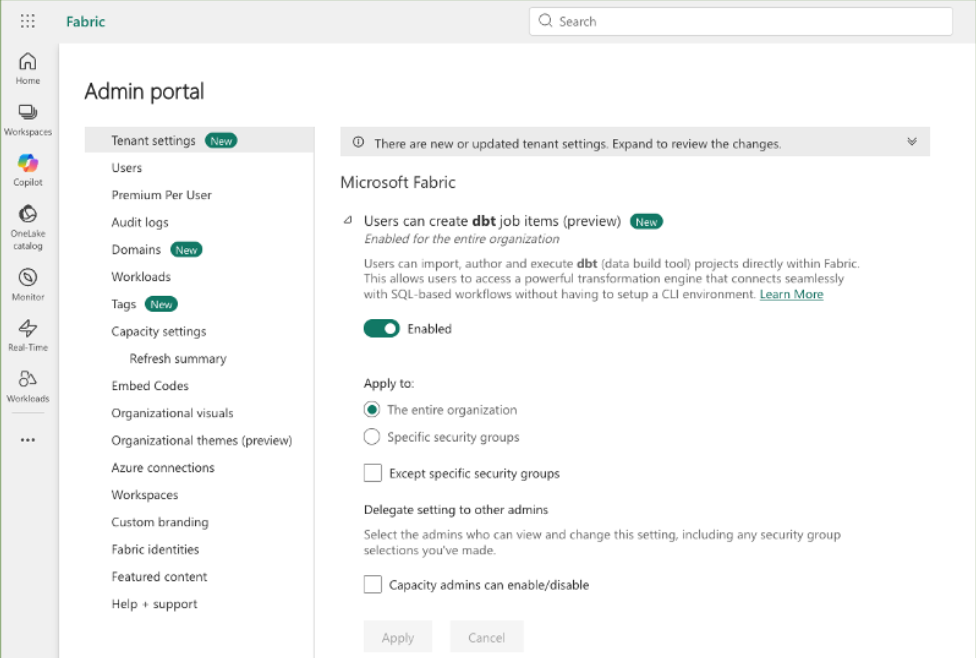
The data engineering community has long embraced dbt (Data Build Tool) for its simple, SQL-first approach to building, testing, and orchestrating data transformations. Historically, teams using dbt with Microsoft Fabric had to rely on external compute (local development machines, GitHub Actions, Azure DevOps pipelines, virtual machines, or standalone orchestration platforms like Airflow). These setups worked, but they added friction: managing environments, handling adapters, configuring authentication, and monitoring transformation jobs across disparate systems.
With dbt jobs now running natively inside Microsoft Fabric, that fragmentation disappears. dbt is no longer an external tool bolted onto the modern data estate, it is now a first‑class, integrated capability of Fabric, providing a unified experience for modeling, testing, scheduling, and monitoring transformations directly inside Fabric workspaces.
dbt, Natively Integrated: What’s New
A Fully Managed dbt Runtime Inside Fabric
Fabric introduces a managed dbt Job Runtime, which provides a versioned and consistent execution environment, including support for dbt Core 1.9 and multiple adapters such as Fabric Warehouse, Azure SQL Database, PostgreSQL, and Snowflake. Users no longer manage local dbt environments, Python dependencies, or containerized execution frameworks, the runtime is automatically maintained by Microsoft.
This significantly reduces operational overhead while improving reliability and performance.
Integrated Development Experience
Fabric’s unified UI now offers a seamless workflow:
- Create dbt jobs directly in your workspace using the "New Item" menu.
You define the project location, warehouse connection, and optional parameters all within the Fabric interface. - Author, validate, and run dbt models inside the browser without the dbt CLI or external adapters.
- Use core dbt commands, including dbt build, dbt run, dbt seed, dbt test, dbt compile, and dbt snapshot.
Engineers can view the dbt project structure, tests, logs, and lineage directly within Fabric, eliminating context switching and enabling collaboration with analysts who may not use code-driven tooling.
Native Scheduling and Orchestration
dbt jobs in Fabric come with built‑in scheduling, allowing teams to automate dbt runs on customized intervals, from minutes to weekly or monthly cycles. Scheduling supports start and end times, timezone selection, and recurring intervals with no external schedulers required.
This allows dbt projects to operate as fully managed, production-grade pipelines without the need for Airflow, Cron, Azure DevOps Pipelines, or GitHub Actions.
Better Governance and Security
Since dbt jobs are Fabric-native:
- Permissions, lineage, and governance integrate directly with the Fabric workspace model.
- Users require workspace Contributor permissions and read/write access to the underlying warehouse.
- All executions participate in Fabric’s built‑in auditing, monitoring, and data governance fabric.
This alignment drastically simplifies compliance for organizations operating under strict data residency, auditing, or regulatory requirements.
Why This Matters
A Unified Transformation Layer for Fabric
Bringing dbt directly into Fabric consolidates:
- Data ingestion
- Transformation
- Governance
- Pipelines
- Reporting and analytics
…into a single analytics platform. Data teams can now develop, test, deploy, and monitor dbt transformations without leaving the Fabric ecosystem.
This closes one of the major gaps in the end-to-end data lifecycle and strengthens Fabric as a unified enterprise analytics platform.
Final Thoughts
- dbt’s native integration with Fabric is more than a convenience, it’s a strategic shift toward simplifying the modern data stack.
- Teams already using dbt can immediately take advantage of Fabric’s managed runtime, built‑in scheduling, and unified governance with minimal friction.
- Organizations new to dbt can adopt the tool in a more accessible, lower‑overhead way enabling SQL analysts and data engineers alike to collaborate on scalable transformation logic.
- By eliminating separate infrastructure and orchestration components, dbt inside Fabric offers a more reliable, secure, and maintainable approach for enterprise-grade data modeling.
dbt is now not just compatible with Fabric….. it is built into the fabric of Fabric.
Want to talk more about Fabric? Feel free to connect with me on LinkedIn!