
Meeting CMMC 2.0 requirements isn't something you can improvise six weeks before a contract deadline. Defense contractors who handle controlled unclassified information (CUI) are subject to a formal set of cybersecurity obligations that now carry real teeth — third-party audits, affirmations, and eventually mandatory inclusion in DoD contracts under DFARS 7012 and its successor clauses. This guide breaks down exactly what you need to do: the controls, the documentation, the technical work, and the assessment process — organized so an IT director or CISO can use it as a working roadmap.
Read MoreThe IT director at a 220-person defense supplier walks into a Wednesday afternoon budget meeting with a question her CFO has asked twice already: "If we want to give Copilot to 50 of our engineers in GCC High, what does that actually cost us this year?" She opens the Microsoft licensing page, scans through commercial Copilot pricing, and quickly realizes none of those numbers apply to her environment. GCC High licensing is not on the public price list. Copilot in GCC High requires prerequisite licenses she has not budgeted for. Copilot Studio adds another line item nobody has scoped. By the end of the meeting, the CFO has approved nothing because nobody can answer the simple question of cost.
Read MoreProgram managers keep asking their leadership when they can use Copilot to summarize contract documents. What do I tell them?
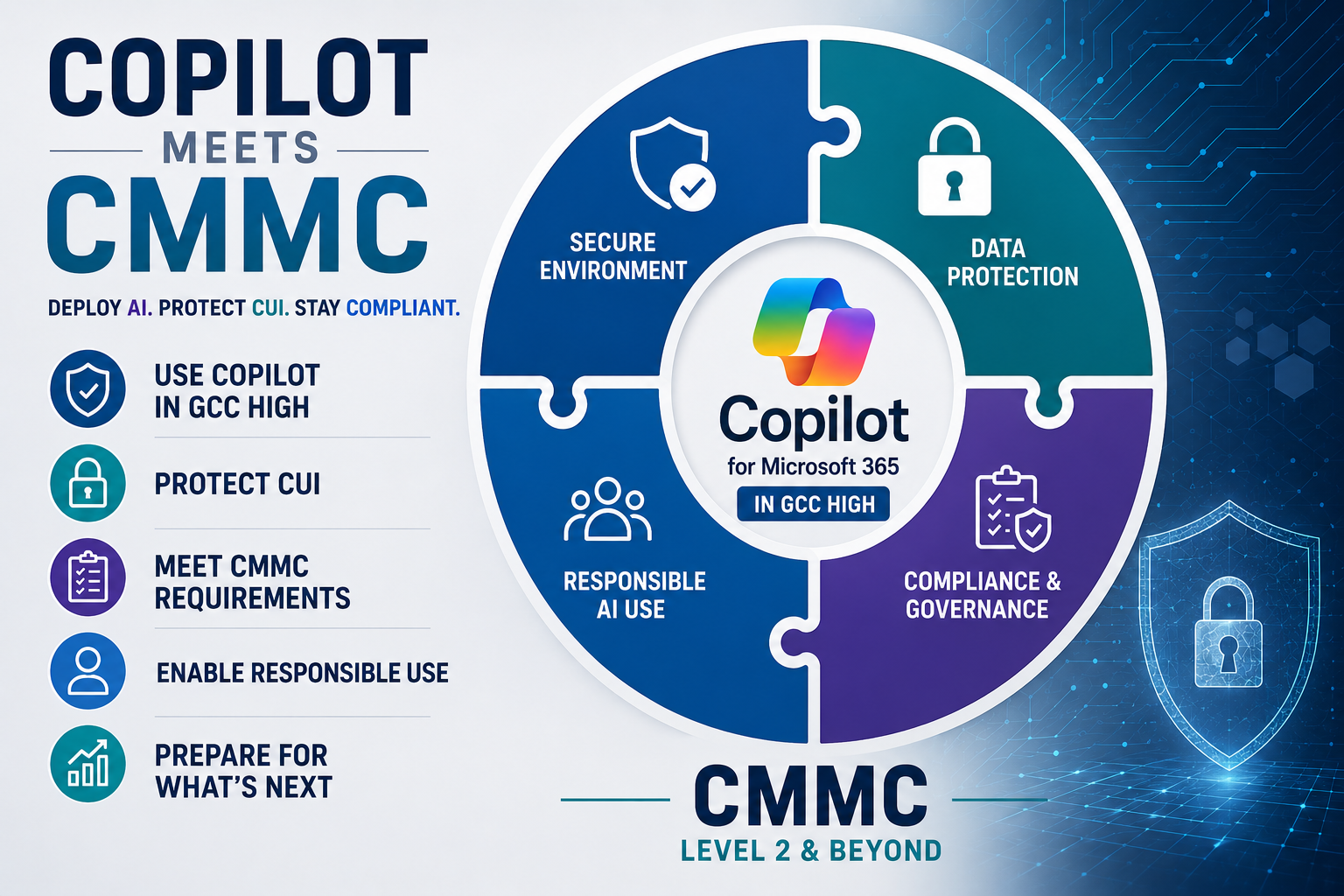
The IT team has been holding the line for two years with a clear answer: not yet, not for anything that touches Controlled Unclassified Information. That answer is no longer current.
Microsoft 365 Copilot reached general availability in GCC High in December 2025, and the question has shifted from "is it available?" to "how do we deploy it without breaking our CMMC posture?"
Read MoreDefense contractors facing CMMC compliance have a fundamental architecture decision to make before they spend a dollar on licensing or migration services. Should you move your entire organization into a Microsoft 365 GCC High tenant, or should you build a CMMC enclave that isolates only the users and systems that handle Controlled Unclassified Information (CUI)? The answer depends on how much of your business actually touches regulated data, what your contracts require, and how much complexity your IT team can realistically manage.
This guide compares both approaches so you can make the right call for your organization's compliance posture, budget, and operations.
Key Insights: What You Need to Know About CMMC Enclave vs. Full GCC High Migration
Read MoreIf your organization handles Controlled Unclassified Information (CUI) under a Department of Defense contract, you already know that Microsoft 365 GCC High is the cloud environment built for your situation. What most defense contractors underestimate is the true GCC High cost once you move past the per-user license fee and into the full picture of migration, operations, and long-term compliance.
This guide breaks down what GCC High actually costs for defense contractors, which Microsoft licensing options apply, and where the budget surprises tend to hide.
Key Insights: What You Need to Know About GCC High Cost and Licensing
Read MoreDefense contractors handling sensitive government data face a critical infrastructure decision that directly affects their eligibility for DoD contracts. Microsoft GCC High has emerged as the de facto standard cloud environment for organizations in the Defense Industrial Base working with Controlled Unclassified Information (CUI) and export-controlled data. If you're evaluating cloud platforms for CMMC compliance or wondering whether your current Microsoft 365 setup meets DoD requirements, understanding the distinction between GCC High and other Microsoft cloud offerings isn't optional-it's essential to your contract eligibility.
Key Insights for Defense Industrial Base (DIB) Compliance
Read MoreOn October 15, 2024, the final rule for the Cybersecurity Maturity Model Certification (CMMC) program was officially published. This rule, codified as 32 CFR, becomes effective on December 16, 2024. The CMMC journey began in 2019 with DFARS Case 2019-D041, and after four years of development, the rule is now finalized. Let’s take a look at the history of the CMMC timeline, what's to come, and how organizations can prepare for what is next.
CMMC Rulemaking Timeline
The rulemaking process illustrated in the graphic below shows a high-level workflow from the Government Accountability Office (GAO).
Figure 1: GAO Federal Rulemaking
Read MoreProtecting sensitive and classified information when working for the Federal Government requires constant vigilance. When the government issues a contract, it must specify to the performing contractor when covered defense information (CDI) or controlled unclassified information (CDI) will be generated under the contract. Many prime contractors “flowdown” every FAR and DFARS clause to subcontractors and vendors without considering if that subcontractor or vendor will be processing, storing, or transmitting CDI. Anticipating where CDI may reside once awarded a contract can be a challenge. Here is guidance on ways CDI can flowdown to subcontractors and the defense industrial base (DIB), and steps those organizations should take before signing an agreement.
An Introduction to DFARS
Read MoreMany companies are currently evaluating how they might fund initiatives necessary to move their businesses towards compliance with the Cybersecurity Maturity Model Certification (CMMC). There are a few ways to fund these initiatives, but many key items have the potential to impact the amount of funding needed to prepare your organization for certification. So, where do you start to appropriately scope the project, and how do you know how much it will actually cost?
Whether your company plans to meet the CMMC objectives or to stop doing business with the Federal Government, keep in mind that cybersecurity is an important part of maintaining your business health and ensuring resiliency in the future. When businesses suffer a cyberattack and cannot afford the cost to recover, they often go bankrupt. In addition to the new federal regulations being pushed out by the Defense Federal Acquisition Regulations (DFARS), many states have laws requiring levels of protection for different types of information. Other federal governments have also enacted cybersecurity protection measures for their citizens (such as GDPR). Not doing so can also leave you open to lawsuits in the event of a breach or incident.
5 Phases for Cybersecurity Compliance
Read MoreGiven the current cyber threat landscape, protecting data has never been more critical. We’ve been helping organizations architect and deploy secure data center and cloud environments for over 20 years. We are a Microsoft Gold Partner, Tier 1 Microsoft Direct Cloud Service Provider and AOS-G, GCC and GCC High reseller. We have the proven expertise and technical certifications to design, implement and provide on-going support for highly customized secure enclaves or “greenfield” environments in Microsoft Azure, Azure Government, and Microsoft 365 Commercial and Government community clouds to meet compliance requirements of NIST 800-171 and CMMC 2.0. We can help your team jumpstart the adoption of a cloud platform with Microsoft 365 and Azure.
Read MoreSubscribe to Daymark Insights
Latest Posts
Browse by Tag
- Cloud (70)
- Microsoft (49)
- Security (47)
- Azure (37)
- Partners (33)
- Data Protection (32)
- Compliance (30)
- Data Center (30)
- Backup (26)
- CMMC (26)
- Daymark News (23)
- Storage (22)
- Data Governance (20)
- GCC High (18)
- Veritas (18)
- Virtualization (18)
- Cybersecurity (17)
- Featured Gov (15)
- Government Cloud (15)
- Cloud Backup (14)
- Disaster Recovery (14)
- Managed Services (13)
- AI (10)
- Industry Expertise (9)
- NIST SP 800-171 (6)
- Networking (6)
- Hybrid Cloud (5)
- Pure Storage (4)
- Copilot (3)
- Reporting (3)
- Services (3)
- AI for Defense (2)
- Cloud Security (2)
- Copilot (2)
- GDPR (2)
- CMMC 2.0 Requirements (1)
- Everpure (1)
- FedRamp AI (1)
- Mobile (1)