

For the third time in less than a decade, the technology industry is navigating a supply chain crisis. This time the catalyst is AI. The hyperscalers' race to build out AI infrastructure has consumed the lion’s share of global semiconductor fabrication capacity, creating supply shortages and cost increases that ripple well beyond AI itself [1]. If you're not building GPU clusters, you might assume this doesn't affect you. It does.
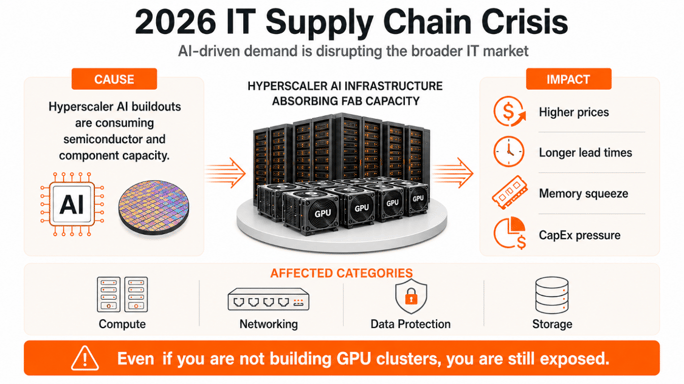
Across the broader IT supply chain, we're seeing quotes on servers, networking gear, data protection and storage systems come back significantly higher than they were at the start of the year. Configurations have climbed well past an increase of 75%, with a handful of outlier quotes exceeding 300% in only a few months [2]. Lead times on many platforms have increased from a few weeks to three, six, and in some cases nine months [2]. NAND and DRAM costs are climbing fast as chip vendors shift limited fab capacity toward higher-margin AI components, further squeezing supply for everything else [1]. This is not just a short-term disruption. New fabrication facilities take years and billions of dollars to bring online, and they are themselves escalating in cost [1].
For IT leaders working within fixed budgets, the math on traditional CapEx hardware purchases has gotten brutal.
How Everpure's Architecture Limits Its Exposure
No vendor is immune to what's happening in the semiconductor market, and Everpure is no exception. But the way Everpure builds its products creates some structural insulation worth understanding.
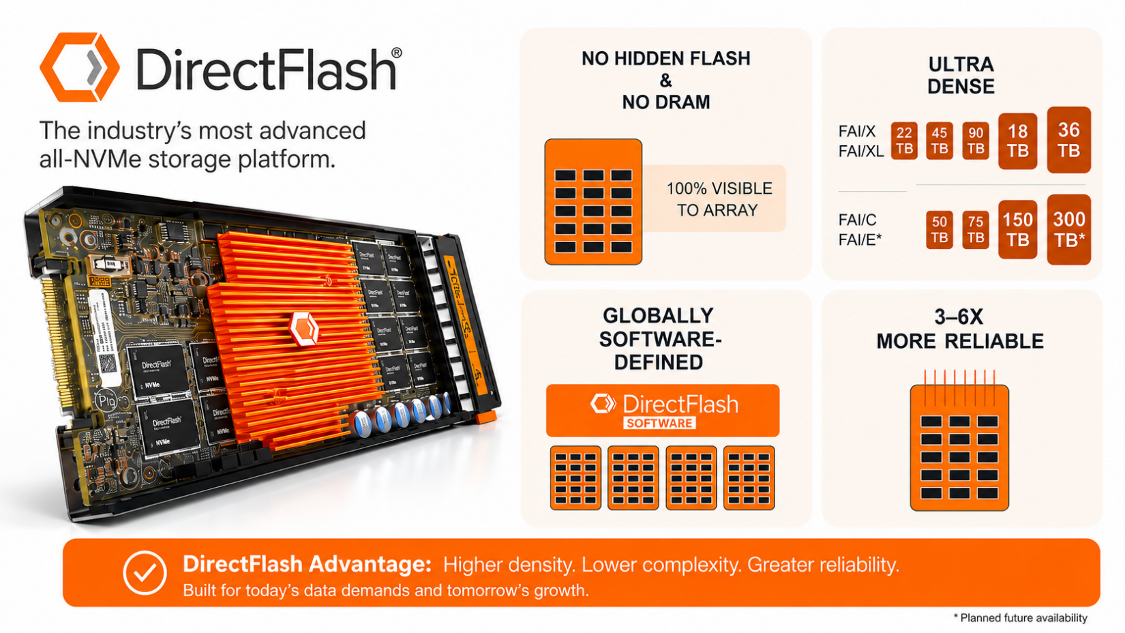
One of the architectural differences that matters most right now is Everpure's DirectFlash Modules, which contain no DRAM at all. Conventional SSDs require DRAM at a ratio of roughly 1000:1 (e.g. 75GB of DRAM for every 75TB of NAND). By eliminating that dependency, they’ve reduced the number of individual components exposed to commodity pricing swings, particularly as DRAM costs climb alongside the broader semiconductor squeeze. Additionally, a greater share of product value in Everpure's lineup comes from software rather than semiconductor-intensive hardware [1]. And Everpure has committed to operating at the low end of its product gross margin range to partially absorb cost increases rather than passing them through in full [1].
That architectural advantage is real, but it only goes so far. Everpure has acknowledged that its average prices have increased more than 70% since the beginning of 2026 [1], and the company announced additional price adjustments in May of 2026, with Evergreen//Forever quotes rising by 30% or more [2]. When you are buying flash storage as a CapEx transaction, you are directly exposed to the volatility of NAND pricing and component availability, regardless of how efficiently the vendor builds its hardware.
Which brings us to the purchasing model that changes that equation.
Why Evergreen//One Derisks Storage Acquisition in This Market
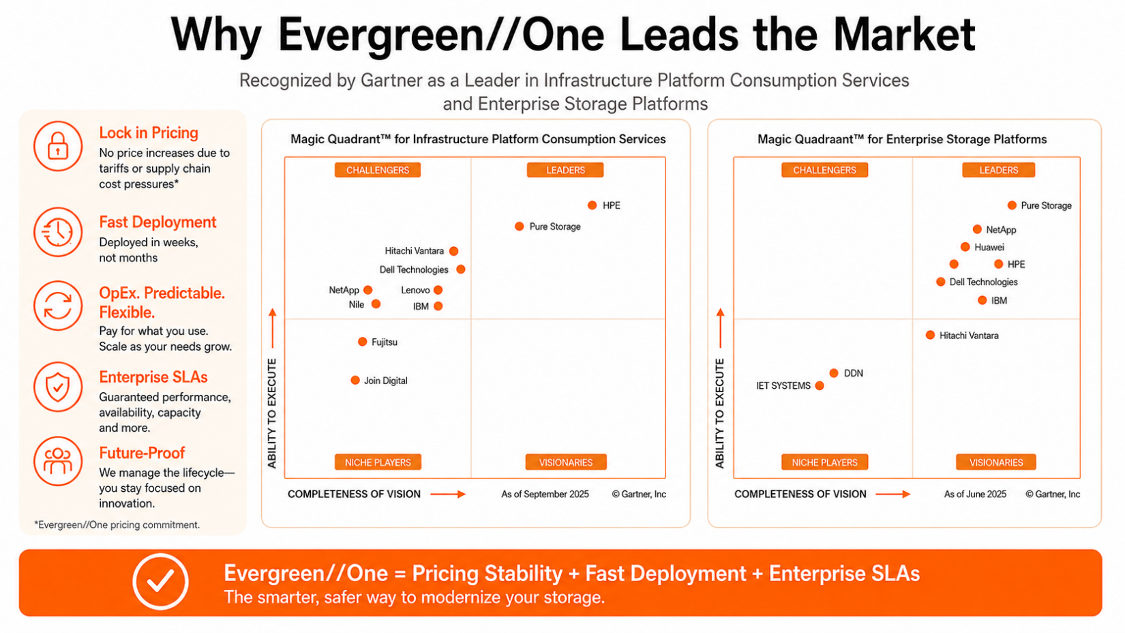
Everpure has explicitly committed to not increasing contracted Evergreen//One pricing in response to tariff and supply chain cost pressures [3]. In practical terms, that means a customer negotiating an Evergreen//One contract today locks in pricing for the full contract term, typically three to five years. Additionally, Everpure has been able to minimize price increases for Evergreen//One customers when compared to Evergreen//Forever. Everpure's May 2026 price adjustments reflected that split clearly: Evergreen//One increased by roughly 5%, compared to 30% or more on Evergreen//Forever [2].
That pricing stability is only part of the picture. Evergreen//One is a consumption-based OpEx model with guaranteed SLAs for performance, availability, and energy efficiency [4]. Everpure manages the infrastructure lifecycle and commits to deployment within a few weeks of order [4], which matters when lead times on comparable CapEx purchases have increased to 3+ months. The refresh cycles that typically leave organizations exposed during volatile markets go away entirely under this model [3].
For organizations currently running Evergreen//Forever subscriptions, Everpure has created a formal transition program to move to Evergreen//One without disrupting the installed environment [3]. That path is available now and worth evaluating against the current cost trajectory of traditional purchases.
The Window to Act Is Open
The supply chain pressures driving this situation are not temporary. As long as AI investment continues at its current pace, competition for semiconductor components will remain intense and flash pricing will stay elevated [1]. Every traditional hardware purchase made under these conditions carries cost risk and delivery risk that a consumption model removes.
If your next FlashArray or FlashBlade deployment is approaching, the conversation with your Daymark team should start with Evergreen//One. The economics have shifted, and the model that keeps your costs predictable and your infrastructure out of the procurement backlog is worth a serious look.
Sources
[1] Everpure, A Letter to Our Customers on the Current Supply Chain Crisis, April 23, 2026. https://www.purestorage.com/company/newsroom/letters/a-letter-to-our-customers-on-the-current-supply-chain-crisis.html
[2] Daymark Architects, field observations, Q1–Q2 2026.
[3] Everpure, How Evergreen//One Storage Subscriptions Protect Your IT Budget from Tariffs and Price Spikes. https://blog.purestorage.com/perspectives/evergreen-one-subscriptions
[4] Everpure, Evergreen//One: Storage-as-a-Service. https://www.purestorage.com/products/staas/evergreen.html